The first event of chess’s newest championship has its winner. Alireza Firouzja won the Total Chess World Championship Tour Pilot in Budapest on Friday, coming back from a set down against Anish Giri and holding a draw in the Armageddon decider. But the event will also be remembered for something that happened far from the title race: Magnus Carlsen choosing not to turn up for games he no longer needed.

Here is what happened, how the new format works, four key positions from the games, and what our students can take from it.
What is Total Chess?
Total Chess is a new championship created by Norway Chess and approved by FIDE. The idea is simple: find the most complete player by mixing three time controls in one event, blitz, rapid and “fast classic” (45 minutes plus 30 seconds a move). Former World Champion Ding Liren compared it to a triathlon.
Budapest (10 to 20 November) was a pilot, a test run with 24 of the world’s best players. The full tour starts in 2027, when the overall winner will be crowned FIDE World Combined Champion, and the tour will also send two players to the 2028 Candidates.
How the format works
- Opening blitz event: a nine-round blitz Swiss to set the seedings. Carlsen won it unbeaten with 7/9.
- Group stage: four groups of six, playing a double round-robin of fast classic games.
- Knockouts: everyone played on, in six brackets deciding every place from 1st to 24th. Each match lasted two days, and each day had 4 blitz games (1 point a win), 2 rapid games (4 points a win) and 1 fast classic game (8 points a win).
What matters is who wins each day, not by how much. If the players win one day each, an Armageddon game decides the match, and the player with more total points picks the colour.
That weighting is important for the rest of this story: one fast classic game is worth as much as everything else that day put together.
The final: Firouzja comes back
Firouzja, Giri, Fabiano Caruana and Maxime Vachier-Lagrave won the four groups. Giri beat Vachier-Lagrave on both days without losing a game. Firouzja needed an Armageddon to get past Caruana, after Caruana won the fast classic game on day two and Firouzja then won the decider when Caruana ran out of time.
In the final, Giri won day one 11–9, thanks mainly to the blitz. Firouzja hit back to win day two 12–8. That set up an Armageddon, and because Firouzja had more points over the two days (21 to 19), he chose Black with draw odds. He held a draw in 35 moves and took the title and $80,000.
Final standings (top four)
| Place | Player | Prize |
|---|---|---|
| 1 | Alireza Firouzja | $80,000 |
| 2 | Anish Giri | $50,000 |
| 3 | Fabiano Caruana | $45,000 |
| 4 | Maxime Vachier-Lagrave |
All four have qualified for the 2027 tour. Caruana won the match for third place 10.5–9.5 on the last day.
Key positions from Budapest
Try each position yourself before you open the answer. All moves are from the official broadcast, and every line was checked with Stockfish.
1. Giri v Firouzja, final, day 2, first rapid game
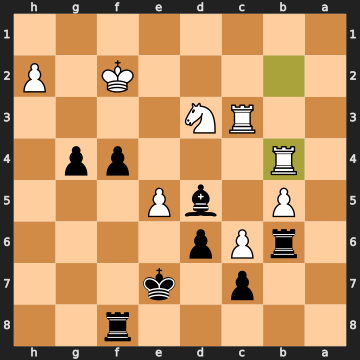
Show the answer
44…g3+! The pawns go forward even though they will be taken. 45.hxg3 fxg3+ 46.Kxg3 Rf3+ and suddenly every black piece is attacking: the rook checks, the bishop on d5 joins in, and the d-pawn can take on e5. After 47.Kg4? dxe5 White’s king was soon caught in a mating net on h4, and Giri resigned after 50…Be6. Instead 44.exd6+! first would have kept the game level. Firouzja had only 25 seconds against almost two minutes, but this win turned the whole day, and he took day 2 by 12–8.
2. Firouzja v Giri, the Armageddon
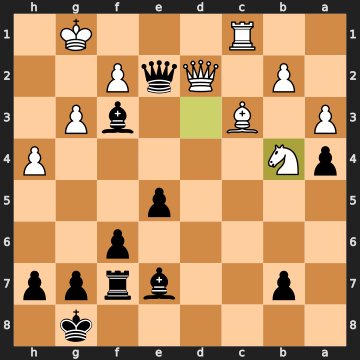
In Armageddon Black only needs a draw, so a draw here meant the title. Firouzja did more than defend: his bishop on f3 and queen on e2 sit right next to the white king, and the engine rates Black clearly better in the final position. With about seven minutes left against Giri’s ten, the game was drawn after 35.Nb4, and that draw made him champion.
The lesson: with draw odds, the safest way to draw is often to play active chess. Passive defence gives your opponent free chances to win.
3. Carlsen v Artemiev, match for 17th, fast classic
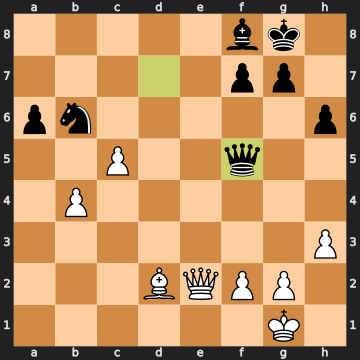
Show the answer
36.cxb6! Carlsen’s 35.c5 had attacked the knight on b6, and Black grabbed the knight on f5 instead. Now the b-pawn is only three squares from queening and nothing can stop it in time: 36…Bd6 37.g3 and the pawn kept marching. The pawn reached b7 on move 40, tying Black down while the white queen attacked the king, and Artemiev resigned on move 49. This was Carlsen’s first win at the fast classic time control in Budapest. The lesson: before you take a piece, check what your opponent’s pawns can do. A passed pawn on the sixth rank is often worth more than a knight.
4. Caruana v Firouzja, semifinal, day 2, fast classic
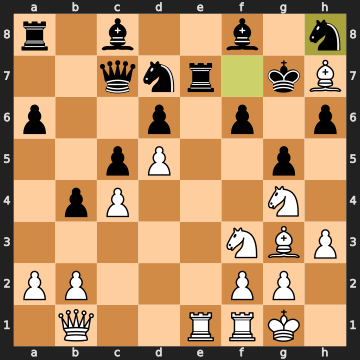
Show the answer
27.Re6! The rook lands on the hole on e6, which no black pawn can ever attack. After 27…Rxe6 28.dxe6 White has a passed pawn on e6, and the bishop on h7 and knights on g4 and f3 surround the black king. 28…Ne5 29.Nfxe5 fxe5 30.Bf5 Qe7? 31.Qe4 and Firouzja resigned. The engine also likes 27.Bg8, but the idea is the same: use the light squares the black pawns can no longer guard. This game was worth 8 points, won Caruana the day 15–5, and forced the Armageddon that Firouzja won when Caruana ran out of time.
Play through the games
- Download the key games (PGN): the final Armageddon, Firouzja’s rapid win over Giri, Carlsen v Artemiev, and both semifinal deciders. Open the file in Lichess, ChessBase or any chess app.
- All games on the official Lichess broadcast, free to replay with an engine.
How the Indian players did
- Arjun Erigaisi reached the final of his bracket but lost both days to Haik Martirosyan, finishing 10th. On day two he led 9–3 going into the fast classic game, and that single game decided the day.
- R. Praggnanandhaa won his last match comfortably and finished 21st.
- R. Vaishali had the result of the opening blitz, beating Hans Niemann and Wesley So, and later beat Arjun in the group stage. She finished 24th after a very hard final day against Nodirbek Abdusattorov.
- World Champion Gukesh did not play: his title match against Javokhir Sindarov starts in Geneva, with game 1 on 24 November.
The Carlsen forfeits
Carlsen had a difficult event. Wins in fast classic would not come, Martirosyan beat him in the group stage, and he finished fifth in his group. That put him in the bracket for 17th place.
Then, in three different matches, games went unplayed:
- Against Bibisara Assaubayeva, day one. Carlsen won the blitz and both rapid games (11.5 out of 12), so the day was already his. He did not come for the fast classic game. Assaubayeva waited at the board until she was given the win by forfeit.
- Against Assaubayeva, day two. The fast classic game was forfeited again. The day finished 10–10, which was enough for Carlsen to go through.
- Against Vladislav Artemiev, in the match for 17th. On day one the official results show both rapid games unplayed and scored to Artemiev, leaving Carlsen 3–9 down, but he then won the fast classic game (position 3 above) to take the day 11–9. On day two he did not appear for the fast classic game, Artemiev won the day 15.5–4.5, and Carlsen won the Armageddon to finish 17th.
Why would he do that?
Two reasons were widely discussed.
Rating. FIDE does not normally rate games played after a match is decided, but the organisers had asked for those games to be rated, and players were told at the technical meeting (which Carlsen missed) that every game would count. A forfeit, on the other hand, is not rated. Reports said a draw against Assaubayeva would have taken Carlsen below 2800 for the first time in about 17 years, and a loss could even have put his world No. 1 ranking at risk.
Carlsen’s own view. He told Norwegian TV that the match was over and that not showing up only meant losing a game that did not matter. He also said he would rather not play much more classical chess, and that the format has a lot of potential but was too complicated the first time.
The reaction
Opinions were sharply split:
- Critics said it disrespected the opponent and the organisers. Hans Niemann called it favouritism, arguing that any other player would have lost the whole match. Ian Nepomniachtchi said a player who does this should be removed from the tournament.
- Others defended him. Some players said they would have done the same with a ranking at stake. Caruana compared it to a tennis player giving up a set and coming back for the next one.
- The organisers said the rules are the same for everyone and nothing had been broken: a player who does not appear simply loses that game. Viswanathan Anand said there is a gap in the rules that needs tightening, and Total Chess has said the pilot is a learning exercise, with the format under review before the tour starts in March 2027.
What students can learn from Budapest
- Play every game properly. At the top level a forfeit is a business decision. For a student, every game is practice you can’t get back, and your opponent came to play you.
- Know the scoring before you play. In this format one fast classic game was worth as much as seven others. In any event, understanding how points are counted changes how you should manage risk.
- A bad start can be recovered. Firouzja lost the first day of the final and still won the title. Arjun led 9–3 and still lost the day. Nothing is decided until the last game ends.
- Be complete. The whole idea of Total Chess is that the best player should be strong at every speed. Practise blitz for intuition, rapid for decisions, and longer games for real calculation.
Congratulations to Alireza Firouzja, the first Total Chess champion. We’ll be following the tour, and the Gukesh–Sindarov World Championship match in Geneva (read our full preview), closely.
Games: official Lichess broadcast. Sources: Chess.com, Chess.com, day 7, ChessBase India, ChessBase, FIDE, Outlook India, Total Chess.
Want a coach to guide you?
Book a free demo class with ChessDepth Academy and get a personal improvement plan.
Book a Free DemoKeep reading
World Championship 2026 Game 3: Gukesh's Surprise, Sindarov's 8 Seconds, Score 1½–1½
Game 3 of the 2026 World Chess Championship, Sindarov vs Gukesh, was a five-hour, 60-move draw. Gukesh's Ri...
NewsWorld Championship 2026 Game 2: A Quick London System Draw, Score 1–1
Game 2 of the 2026 World Chess Championship, Gukesh vs Sindarov, ended in a 20-move draw by repetition in t...