Rook endgames are the most common type of endgame in chess, so common that the old saying goes “all rook endgames are drawn.” That is not quite true, but it contains a lesson: rook endgames are full of resources for both sides. Two positions form the foundation of all rook endgame knowledge: the Lucena position (how to win) and the Philidor position (how to draw).
If you learn only two endgame positions this year, learn these.
The Lucena position: building a bridge
The Lucena position arises when the stronger side has a pawn on the seventh rank, their king is in front of it on the queening square, and the defending king is cut off.
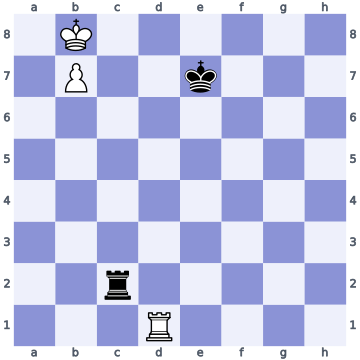
White’s king is on b8 in front of the pawn. Black’s rook on c2 stops the king from stepping out to the c-file, and White’s rook on the d-file keeps Black’s king away from the pawn. If White’s king steps out to a7, Black will check it from the side and the back again and again. The winning plan is to build a bridge: use your rook as a shield against the checks.
The winning method:
- 1.Rd4! The key move: the rook goes to the fourth rank, ready to block checks later.
- Black waits, for example 1…Rc1.
- 2.Ka7 The king leaves the pawn’s square.
- 2…Ra1+ 3.Kb6 Rb1+ 4.Kc6 The king walks towards the rook.
- 4…Rc1+ 5.Kb5 Rb1+ 6.Rb4! The bridge: White’s rook blocks the check, and the pawn will queen.
Remember: rook to the fourth rank first, then walk the king out and block the checks with the rook.
The Philidor position: the third-rank defence
Now the defender’s view. You are a pawn down, and your opponent’s king and pawn are advancing. If your king reaches the queening square in time, the Philidor defence draws.
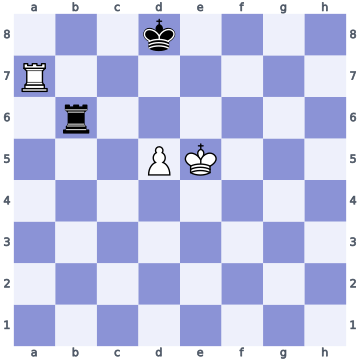
Black’s king is on d8, in front of the pawn. The key is Black’s rook on the sixth rank (the third rank from Black’s side). It stops White’s king from advancing to the sixth rank.
The drawing method:
- Keep your rook on your third rank (here, the sixth rank) and move it along that rank to wait, for example 1…Rc6.
- White cannot make progress without pushing the pawn. When White plays 2.d6, the pawn no longer shelters the white king from checks along the files.
- Now the rook goes to the back: 2…Rc1! It checks the king from behind: 3.Ke6 Re1+. White’s king has nowhere to hide from the checks, and the game is a draw.
Remember: rook on your third rank until the pawn advances, then check from behind.
Common mistakes
- Defender: passive rook on the back rank too early. If your rook goes to the eighth rank before the pawn reaches the sixth, White’s king can come to the sixth rank and set up mating threats.
- Attacker: going straight for the queen. In the Lucena, stepping out with the king before putting the rook on the fourth rank allows endless checks.
- Both sides: a passive rook. In rook endgames, an active rook is often worth a pawn. Attack pawns and cut off the enemy king. Don’t just defend.
General principles for rook endgames
- Rooks belong behind passed pawns, both your own and your opponent’s.
- Cut off the enemy king, even by one file. It can decide the game.
- Activate your king: it is a strong piece in the endgame.
- Activity beats material. Giving up a pawn to activate your rook is often correct.
How to practise
Set up both positions on a board (or in the board editor on our Resources page) and play them out against a friend or a coach, from both sides, until you can win the Lucena and hold the Philidor without thinking. These ideas come up again and again in real games.
Our worksheet Grinding It in the Endgame contains 20 rook endgame problems, from basic positions like these to advanced practical endings.
Want a coach to guide you?
Book a free demo class with ChessDepth Academy and get a personal improvement plan.
Book a Free DemoKeep reading
Introducing ChessDepth AI: Turn Any Chess Screenshot into a Board
ChessDepth AI is free and in beta. Drop in a screenshot or a book diagram and get a board you can edit, the...
TrainingHow to Use AI and Modern Tools to Improve at Chess Faster
Engines, game reviews, human-like AI, chatbots and puzzle trainers can speed up your progress, or slow it d...