For a long time, I thought teaching was simple. You know the subject, you explain it clearly, and the student learns. Done.
Years of coaching chess, and now working as an engineer and PhD scholar, have changed my mind completely. In engineering we have a name for problems where you must balance many goals at once, under uncertainty, while the situation keeps changing: we call them optimisation problems. The more I teach, the more I believe a good chess lesson is one of the hardest optimisation problems there is.
Here’s why, and what it means for students, parents and coaches.
Many goals, all pulling in different directions
In every lesson, a coach is trying to achieve several things at the same time:
- Deep understanding, but also steady progress through the material
- Challenge, without breaking confidence
- Results now, like the next tournament, while building habits that pay off for years
- Enjoyment, because a student who stops enjoying chess eventually stops playing
The problem is that these goals compete. Spend longer on one idea and the pace drops. Give a harder puzzle and confidence may dip. Focus on winning next weekend and you may skip the slow, boring work that builds real strength.
So there is no single “perfect lesson”. There are only trade-offs, and every coach is choosing between them, whether they realise it or not.
It happens across several “spaces” at once
What makes teaching even more interesting is that it doesn’t happen in one dimension. A coach works across several spaces at the same time.
1. What the coach controls. Which topic to teach, which example to show, how fast to go, how hard the next exercise should be, when to explain and when to let the student struggle a little, when to praise and when to push. These are dozens of small decisions, made in real time, in the middle of a lesson.
2. What we are trying to achieve. Understanding, confidence, enjoyment, rating, long-term habits. These are the goals above, and they rarely all improve together.
3. The student’s inner state. This is the part that is easiest to forget. A student isn’t one number like a rating. They have:
- a knowledge state: what they understand
- a skill state: what they can actually do over the board, under pressure (which is not the same thing)
- an emotional state: confidence, nerves, frustration after a loss
- a motivational state: why they are playing chess at all
Every decision a coach makes affects all of these at once, sometimes in opposite directions. A tough puzzle can raise a student’s skill and lower their confidence in the same minute.
4. Time. Each lesson moves the student to a new place, and that changes what the next lesson should be. Teaching isn’t one decision. It’s a long chain of decisions, where today’s choice shapes tomorrow’s options.
The hidden part: you can’t see what a student really knows
In engineering, controlling a system is much easier when you can measure it directly. In teaching, you can’t.
A coach never sees a student’s understanding directly. You only see the moves they play and the answers they give, and those can mislead you. A correct answer might be a lucky guess. A blunder might come from nerves, not from a lack of knowledge.
This is why one of the most powerful questions in chess coaching is simply: “Why did you play that move?”
The answer tells you what is really happening inside the student’s head. A coach who only checks whether the move was right or wrong is, in a sense, teaching blind.
The system keeps changing, and the feedback is slow
Two more things make chess teaching tricky.
The student keeps changing. A drill that worked brilliantly last month stops working once the student has absorbed it. What helps a 900-rated player can bore a 1400 player. A coach has to keep adjusting.
The results arrive late. A habit you build today may only show up in tournament games months from now. That makes it tempting to chase quick wins and to judge progress by this week’s results alone.
A simple chess example
Imagine a beginner who keeps missing pieces left hanging.
- Option A: Teach them to grab every free piece. Their results improve almost immediately.
- Option B: Teach them to first ask, before every move, “What is my opponent threatening?” This slows them down, and they may even lose a few games at first.
Option A wins games tomorrow. Option B is what makes them a strong player for years.
Here is what Option A looks like when it goes wrong.
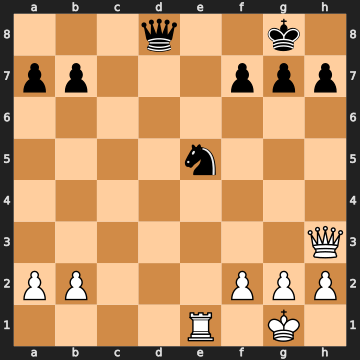
A student trained only to grab free pieces plays 1.Rxe5 at once. Then 1…Qd1+ 2.Re1 Qxe1# is checkmate: the rook was the only piece guarding White’s back rank. A student trained in Option B first asks what Black is threatening, sees the weak back rank, and plays a calm move such as 1.Qe3, which attacks the knight a second time and guards e1. White stays a rook for a knight ahead and keeps winning.
And here is the question from Option B in its simplest form, the first threat almost every young player meets:
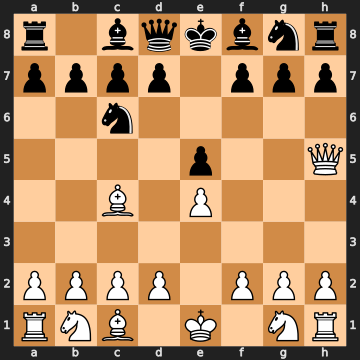
White threatens 4.Qxf7#, the Scholar’s Mate. A natural developing move such as 3…Nf6?? loses at once. A student who asks the question finds 3…g6, which blocks the queen’s line to f7 and attacks the queen (3…Qe7 also defends). It’s one question, asked every move, and it saves hundreds of games over a chess career.
Neither option is wrong. But choosing between them, and knowing when to switch from one to the other, is exactly the kind of trade-off coaching is made of.
Every student needs different “weights”
If there’s one lesson I’ve learned, it’s this: the right balance is different for every student.
- A nervous young beginner needs confidence and enjoyment weighted very heavily.
- An ambitious tournament player can handle tougher challenges and more honest criticism.
- A student coming back after a bad tournament may need encouragement before anything else.
Good teaching isn’t following one fixed method. It’s knowing which goals matter most for this student, right now, and noticing when that changes.
In a group class, it’s harder still: one explanation and one pace have to serve several students at once, each at a different point in their journey. That’s why we treat one-to-one and group classes differently at ChessDepth.
What this means for students and parents
A few practical takeaways:
- Don’t judge progress by one week. Real improvement often comes after a quiet period of building habits.
- Some slow phases are a good sign. If a student is thinking longer and checking threats, they’re building the skills that matter.
- Talk to your coach. The more a coach knows about a student’s confidence, goals and nerves, the better they can balance the lesson.
- Enjoyment is not optional. A student who loves the game will keep improving long after any single lesson is forgotten.
Final thought
Teaching chess looks simple from the outside: show a position, explain the idea, move on. In reality, every good lesson is a careful balance of many goals, across many dimensions, for a student whose mind you can never see directly.
Great coaches solve this problem every day, often without even noticing they’re doing it. They read a face, sense frustration, push a little harder or ease off, all in a few seconds.
That, to me, is what makes teaching one of the most fascinating problems I’ve ever worked on.
Coaches and parents: which trade-off do you find hardest to balance? I’d love to hear your thoughts.
ChessDepth: Think Deep. Play Deeper!
Want a coach to guide you?
Book a free demo class with ChessDepth Academy and get a personal improvement plan.
Book a Free DemoKeep reading
Why Study the Chess Classics? Great Players of the Past, Their Styles and Famous Positions
Why old master games still make you stronger today: the great players from Philidor to Fischer, India's leg...
TrainingHow to Play Blindfold Chess: Step-by-Step Visualization Guide
Blindfold chess trains chess visualization like nothing else. A six-step method from learning the squares t...