Every strong player you admire grew up on the same diet: the games of the masters who came before them. Engines are stronger than any human who ever lived, yet coaches still send their students back to games played 100 or even 170 years ago.
This article explains why, introduces the great players of the past and how each of them played, including India’s own legends, and gives you four famous positions to solve.
Why old games still make you stronger
1. The ideas are easy to see. In a modern grandmaster game both players know the plans and stop each other, so the ideas stay hidden in the notes. In the classics, one player often did not know the idea yet. The plan is carried out in full, on the board, where you can see it.
2. Chess is a game of patterns. A back-rank mate, a bishop sacrifice on h7, a rook on the seventh rank: you find these in your own games because you have seen them before. Classic games are where these patterns were first played, in their cleanest form.
3. You learn chess in the order it was discovered. First came open games and attack (Morphy, Anderssen). Then came positional rules (Steinitz), technique (Capablanca) and new ideas about the centre (Nimzowitsch, Réti). A student’s own growth follows the same path, so the old masters are natural teachers for each stage.
4. They show you a plan, not only a move. An engine gives you a number and a best move. A classic game shows a whole story: the opening, the plan, the attack or the endgame that wins it.
5. They are fun. Queen sacrifices, king hunts and endgame studies that look impossible. Enjoying chess is the best reason to keep studying it.
The great players and how they played
| Player | Years | Known for |
|---|---|---|
| François-André Philidor (France) | 1726–1795 | The first great chess thinker. He wrote that “pawns are the soul of chess” and showed how pawn structure decides the plan. |
| Adolf Anderssen (Germany) | 1818–1879 | Fearless attacker of the Romantic era. Winner of the Immortal Game (1851) and the Evergreen Game (1852). |
| Paul Morphy (USA) | 1837–1884 | Fast development, open lines, and only then the attack. He was far ahead of everyone in his time. |
| Wilhelm Steinitz (born in Prague, later USA) | 1836–1900 | The first official World Champion (1886). He taught that you attack only when you hold an advantage, and that small advantages add up. |
| Emanuel Lasker (Germany) | 1868–1941 | World Champion for 27 years (1894–1921), the longest reign. A fighter and a practical player who was superb in defence. |
| José Raúl Capablanca (Cuba) | 1888–1942 | World Champion 1921–1927. Clear, simple moves and perfect endgame technique. He made chess look easy. |
| Akiba Rubinstein (Poland) | 1880–1961 | The great master of rook endgames and of quiet, logical play. |
| Aron Nimzowitsch (Latvia, later Denmark) | 1886–1935 | Author of My System. He gave us prophylaxis, the blockade and overprotection. |
| Alexander Alekhine (Russia, later France) | 1892–1946 | World Champion 1927–1935 and 1937–1946. Deep preparation and long, complicated combinations. |
| Mikhail Botvinnik (Soviet Union) | 1911–1995 | Three-time World Champion and the father of scientific training: preparation, fitness and analysing your own games. |
| Mikhail Tal (Latvia) | 1936–1992 | “The Magician from Riga”, World Champion in 1960 at the age of 23. Daring sacrifices that were very hard to answer at the board. |
| Bobby Fischer (USA) | 1943–2008 | World Champion in 1972. Clear, energetic and accurate play. He won the “Game of the Century” at the age of 13. |
Each of them teaches something different. Morphy teaches you to develop. Steinitz teaches you to be patient. Capablanca teaches you to keep it simple. Tal teaches you to be brave.
India’s chess legends
Chess is widely believed to have begun in India, as the old game of chaturanga. Two players from the subcontinent belong in any list of classics.
Mir Sultan Khan (1903–1966): the natural genius
Sultan Khan was born in a village in Punjab, in undivided British India (the area is now in Pakistan). He grew up playing the Indian form of chess, where the rules were a little different, and learned the international rules only as a young man. He had almost no book knowledge of openings.
In 1929 he travelled to England, and what followed is one of the most remarkable stories in chess:
- He won the British Championship three times, in 1929, 1932 and 1933.
- At Hastings 1930–31 he beat José Raúl Capablanca, the former World Champion who almost never lost. Capablanca called him a genius.
- He won a match against Savielly Tartakower in 1931 and played top board for the British Empire team at three Olympiads.
His international career lasted less than five years. In 1933 he went home and hardly played serious chess again. In 2024, FIDE awarded him the title of Honorary Grandmaster, 58 years after his death.
His style: slow, patient and stubborn. He often came out of the opening with a modest position, because he did not know the theory. Then he outplayed his opponents in the middlegame and the endgame, squeezing small advantages for hours. His games show that understanding matters more than memorised openings.
Viswanathan Anand (born 1969): the Tiger of Madras
Anand changed Indian chess for ever. He learned the game from his mother at the age of six and became famous as a teenager for playing strong moves at lightning speed.
- 1987: World Junior Champion, the first Indian to win the title.
- 1988: India’s first Grandmaster, at the age of 18.
- 2000: FIDE World Champion.
- 2007: undisputed World Champion, a title he defended in matches against Vladimir Kramnik (2008), Veselin Topalov (2010) and Boris Gelfand (2012). That makes him a five-time World Champion.
His style: fast, clear and universal. Anand calculates quickly, is superbly prepared in the opening, and is equally at home attacking, defending or grinding out an endgame. He won the world title in three different formats: knockout, tournament and match.
When Anand became a Grandmaster in 1988, India had one. Today it has 100 Grandmasters. Almost every one of them grew up studying his games.
Four famous positions to solve
Set each one up on a board, or picture it in your head, and think before you open the answer.
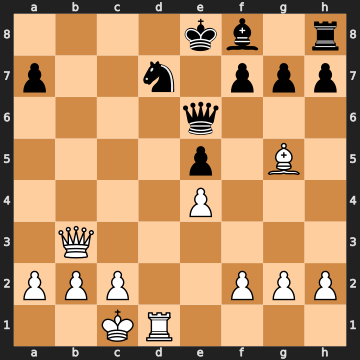
1. Morphy’s Opera Game (Paris, 1858)
Paul Morphy played this game in a box at the opera in Paris, against the Duke of Brunswick and Count Isouard, who were consulting together. All of White’s pieces are in play. Black’s king is still in the centre and two of Black’s pieces have never moved.
Show the answer
16.Qb8+!! White gives up the queen. After 16…Nxb8 comes 17.Rd8#. The bishop on g5 protects the rook, and the black king has no square. The lesson: when your pieces are developed and the enemy king is stuck in the centre, look for a way to open lines, even at the cost of material.
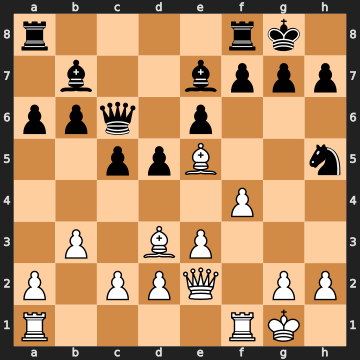
2. Lasker’s double bishop sacrifice (Amsterdam, 1889)
Emanuel Lasker was 20 years old when he played this against Johann Bauer. Both white bishops point at the black king. The knight that normally guards h7 from f6 has just been exchanged.
Show the answer
15.Bxh7+! Kxh7 16.Qxh5+ Kg8 17.Bxg7!! The second bishop goes too. After 17…Kxg7 18.Qg4+ Kh7 19.Rf3 the rook joins the attack and Black must give up the queen to stop mate: 19…e5 20.Rh3+ Qh6 21.Rxh6+ Kxh6 22.Qd7, and the queen forks both black bishops. This was the first famous double bishop sacrifice, and the pattern has won many games since.
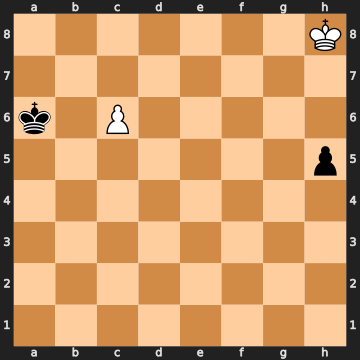
3. Réti’s study (1921)
Richard Réti composed this position. It looks hopeless for White. The black pawn runs to h1, and White’s king is far outside its square. White’s own pawn seems easy for the black king to stop.
Show the answer
1.Kg7! h4 2.Kf6! Kb6 (if 2…h3, then 3.Ke7 h2 4.c7 Kb7 5.Kd7 and both sides make a queen) 3.Ke5! Now White threatens two things at once. If 3…h3, then 4.Kd6 h2 5.c7 and White queens too. If 3…Kxc6, then 4.Kf4 and the king catches the h-pawn. The king walks along the diagonal and chases two goals with one journey. It is one of the most important ideas in all endgames.
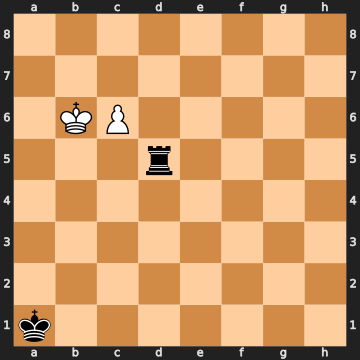
4. The Saavedra position (1895)
Named after Fernando Saavedra, a Spanish priest living in Glasgow, who found the winning move that the experts had missed. White’s pawn is one step from the seventh rank, but the black rook keeps giving checks.
Show the answer
1.c7 Rd6+ 2.Kb5! (2.Kc5 allows 2…Rd1 and 3…Rc1+) 2…Rd5+ 3.Kb4 Rd4+ 4.Kb3 Rd3+ 5.Kc2! The checks have run out, but Black has a trick: 5…Rd4! If White now makes a queen, 6…Rc4+! 7.Qxc4 is stalemate. So White plays 6.c8=R!!, promoting to a rook. The threat is 7.Ra8+, and after 6…Ra4 7.Kb3! White threatens both the rook and mate on c1. Black cannot stop both. The lesson: a queen is not always the right piece to promote to.
How to study a classic game
- Choose one game. A short, famous one is best to begin with.
- Play it on a real board. Moving the pieces by hand helps you remember far more than clicking through on a screen.
- Guess the move. Cover the moves of the winning side. Before each one, decide what you would play, then compare.
- Stop at the turning points. Ask why the loser’s position went wrong. Usually it is a principle: slow development, an unsafe king, a weak pawn.
- Write down one lesson. One sentence is enough, such as “Open the centre when the enemy king has not castled.”
- Only then check with an engine. Use it to test your own questions, not to replace your thinking.
One game a week is plenty. In a year you will know fifty classic games, and you will start to see their ideas in your own positions.
Where to start
- Beginners: Morphy’s Opera Game, Anderssen’s Immortal Game and Evergreen Game. Irving Chernev’s book Logical Chess: Move by Move explains every single move of 33 master games.
- Improving players: Capablanca’s Chess Fundamentals and his endgames, and Rubinstein’s rook endgames.
- Tournament players: Nimzowitsch’s My System, Alekhine’s best games, Tal’s attacking games, and Fischer’s My 60 Memorable Games.
- For Indian chess history: Anand’s own book Vishy Anand: My Best Games of Chess, and Daniel King’s biography Sultan Khan: The Indian Servant Who Became Chess Champion of the British Empire.
You can practise many of these ideas on our site. The checkmate patterns course in the Chess Lab covers the back-rank, smothered and Arabian mates. The Endgame trainer lets you play the Lucena and Philidor positions against Stockfish, and our article on rook endgames explains them step by step. To find the tactics in the positions above more quickly, use the checks, captures and threats routine.
The old masters did not have engines, databases or online lessons. They had a board, their own ideas and each other’s games. Their games are still the best free chess course ever made.
Frequently asked questions
Are old chess games still useful when engines are so strong?
Yes. Engines tell you which move is best, but classic games show you why, in a form a human can remember. In older games one side often carries out a clear plan without much resistance, so the idea is easy to see and to copy in your own games.
Which classic chess game should a beginner study first?
Start with Paul Morphy’s Opera Game (Paris, 1858). It is only 17 moves long and teaches fast development, open lines and a beautiful queen sacrifice. After that, try Anderssen’s Immortal Game and a few of Capablanca’s endgames.
How many classic games should I study?
One game a week, studied properly, is enough. Play through it on a board, guess the winner’s moves before you look, and write down one lesson. Fifty games a year done this way will change how you play.
Which old players should I study for my level?
Beginners learn most from Morphy and Anderssen (development and attack). Improving players should add Capablanca and Rubinstein (simple plans and endgames). Stronger players can go on to Steinitz, Nimzowitsch, Alekhine, Botvinnik, Tal and Fischer.
Want a coach to guide you?
Book a free demo class with ChessDepth Academy and get a personal improvement plan.
Book a Free DemoKeep reading
How to Play Blindfold Chess: Step-by-Step Visualization Guide
Blindfold chess trains chess visualization like nothing else. A six-step method from learning the squares t...
TrainingIntroducing ChessDepth AI: Turn Any Chess Screenshot into a Board
ChessDepth AI is free and in beta. Drop in a screenshot or a book diagram and get a board you can edit, the...