Most games below master level are not lost to brilliant combinations. They are lost to simple oversights: a piece left hanging, a check that was not noticed, a threat that was ignored. The CCT method is the cure. It is a short checklist you run before every important move:
Checks · Captures · Threats
It sounds almost too simple. But strong players do this automatically, and the more you practise it, the faster and more natural it becomes.
Why CCT works
Forcing moves limit your opponent’s choices. A check must be answered. A capture usually must be recaptured. A threat must be dealt with. Because forcing moves narrow the possibilities, they are the moves you can calculate accurately, and they are where tactics hide.
Looking at forcing moves first also protects you: if you check your opponent’s forcing moves too, you will notice most of their tricks before they happen.
Step 1: Checks
List every check you can give, even ones that look silly. Many winning combinations start with a check that loses material at first sight. Ask:
- After this check, where can the king go?
- Can the check be blocked or the checking piece captured?
- Is it checkmate?
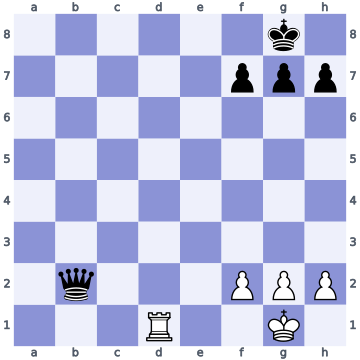
Show the answer
1.Rd8#. The black king is trapped behind its own pawns on f7, g7 and h7, and nothing can block or capture on d8. The black queen on b2 looks dangerous, but checks come first, and this one ends the game.
This is the classic back-rank mate. If you had only looked at the black queen’s threats, you might have played a defensive move and missed an instant win.
Step 2: Captures
Next, look at every capture, for both sides:
- Which of my pieces can capture something?
- Which enemy pieces are undefended (“loose pieces drop off”)?
- If I capture, what does my opponent recapture with, and who comes out ahead?
Count attackers and defenders. If you attack a piece twice and it is defended once, you can usually win it.
Step 3: Threats
Finally, look for moves that create a threat your opponent must answer:
- Attacking an undefended or more valuable piece.
- Threatening checkmate.
- Setting up a fork, a pin or a skewer next move.
- Attacking a pinned piece.
Threats are slower than checks and captures, so check whether your opponent has a forcing reply first.
Don’t forget your opponent’s CCT
The second half of the method is defensive. Before you play your move, ask:
“After my move, what are my opponent’s checks, captures and threats?”
This one question prevents most blunders. If your move leaves a piece loose, walks into a fork or allows a back-rank check, you will usually see it now, not after your opponent plays it.
Putting CCT into your thinking process
On every move in a serious game:
- What did my opponent’s last move change? What does it threaten?
- Run CCT for me: checks, captures, threats.
- If nothing forcing works, make a positional move (improve your worst piece, follow your plan).
- Blunder check: run CCT for your opponent after your chosen move.
- Play the move.
It takes a few seconds once it becomes a habit, and it saves whole games.
How to practise
- Solve puzzles with the checklist. Before choosing a move, say the list out loud: “Checks: … Captures: … Threats: …”
- Play longer games (15 minutes or more per side) so you have time to build the habit. In blitz, the habit gets skipped.
- Review your losses and mark every moment you missed a check, a capture or a threat. You will see the same patterns repeating.
At ChessDepth Academy, the CCT method has its own worksheet with graded problems, from simple loose-piece captures up to multi-move combinations. Ask your coach for it, or download it from the Student Area once it is live.
Want a coach to guide you?
Book a free demo class with ChessDepth Academy and get a personal improvement plan.
Book a Free Demo