Ask any coach what wins games at club level and you will hear the same answer: tactics. Most games between developing players are not decided by deep strategy. They are decided when one side leaves a piece undefended, or misses a two-move combination. The good news is that tactics are built from a small number of patterns. Once you can recognise them, you start seeing chances that were always there.
This article covers the six patterns every player should know, with a position for each one to solve.
1. The fork
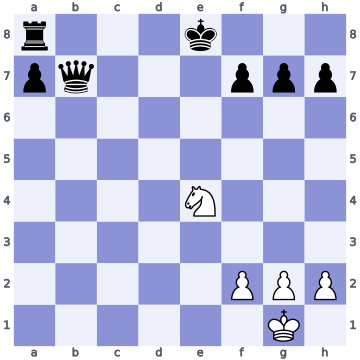
A fork is one piece attacking two (or more) enemy pieces at the same time. The opponent can usually save only one. Any piece can fork, even a pawn or the king, but the knight is the champion forker: it jumps over pieces, and nothing it attacks can attack it back the same way.
Show the answer
1.Nd6+! The knight checks the king on e8 and attacks the queen on b7 at the same time. Black must deal with the check (for example 1…Kd8), and then 2.Nxb7 wins the queen for a knight.
How to spot forks: look for two enemy pieces, especially the king and an undefended piece, that sit a knight’s jump apart from the same square. Squares like c7, f7, c2 and f2 are classic fork squares in the opening.
2. The pin
A pin happens when a piece cannot move without exposing a more valuable piece behind it.
- In an absolute pin, the piece behind is the king, so the pinned piece is not legally allowed to move.
- In a relative pin, the piece behind is valuable (often the queen or a rook), so moving is legal but costly.
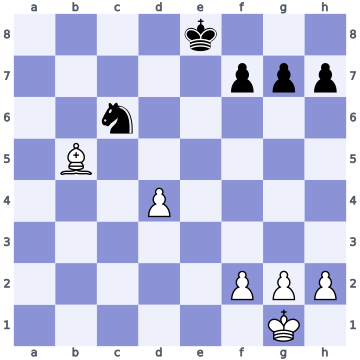
The key idea: a pinned piece is a target. Attack it again, especially with a pawn, and it often cannot escape.
Show the answer
1.d5! attacks the pinned knight with a pawn. The knight cannot move because the king is behind it. Even if Black unpins with 1…Ke7, White simply plays 2.dxc6 and wins a whole piece.
3. The skewer
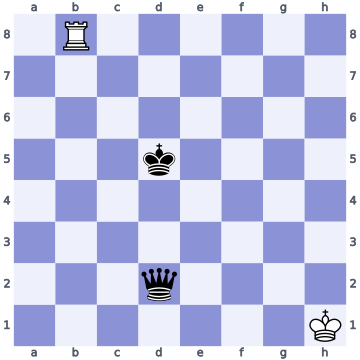
A skewer is a pin in reverse: you attack a valuable piece, it moves out of the way, and you capture the piece behind it. Skewers are made by long-range pieces (queens, rooks and bishops) and are especially common in endgames, when kings are exposed.
Show the answer
1.Rd8+! checks the king along the d-file. The king must step off the file (for example 1…Ke5), and 2.Rxd2 collects the queen behind it.
4. Discovered attack
A discovered attack happens when you move one piece out of the way and uncover an attack by the piece behind it. It is powerful because you get two threats at once: whatever the moving piece does, plus the attack you revealed.
When the uncovered piece gives check, it is a discovered check. When both the moving piece and the uncovered piece give check, it is a double check. Then the king must move, because no single move can block or capture two checking pieces.
How to spot them: whenever your rook, bishop or queen is lined up with an enemy piece and only one of your own pieces is in between, ask: where can that piece go with a threat?
5. Removing the defender
Sometimes a target is protected only once. If you can capture, chase away or distract that defender, the target falls. Typical versions are:
- Capturing the defender (often trading a piece that guards a key square).
- Deflection: forcing the defender to move away, often with a check or a sacrifice.
- Overloading: one piece is defending two things at once, so it cannot do both jobs.
How to spot it: for every enemy piece, count its attackers and defenders. If a piece or square has only one defender, look for a way to make that defender leave.
6. Back-rank weakness
A king tucked behind its own pawns is safe from many attacks, but it can also be trapped. If the back rank is not covered, a single rook or queen check can be checkmate. We look at this pattern closely in our article on the CCT method.
How to train tactics (15 minutes a day)
- Solve easy puzzles, quickly. Pattern recognition grows from volume. Use the Lichess puzzle trainer or the puzzles your coach assigns, and aim for a high success rate rather than very hard problems.
- Name the pattern. After each puzzle, say out loud which pattern it was: fork, pin, skewer, discovery, deflection. Naming it helps you remember it.
- Repeat your mistakes. Keep a small list of puzzles you failed and solve them again a week later.
- Look for tactics in your own games. After every game, check the moments where material changed hands. Was there a fork you missed? A pin you walked into?
- Before every move, check for checks, captures and threats, for both sides. This one habit prevents most blunders.
Tactics are the fastest way to improve your results. Master these six patterns and you will win more games against players who have not.
Want a coach to guide you?
Book a free demo class with ChessDepth Academy and get a personal improvement plan.
Book a Free Demo